Heritage & Roots · Explorers
What Makes Kuala Lumpur's Cultural Scene Worth Knowing
Kuala Lumpur began as a tin landing where two rivers meet. Its mosques, temples, Malay kampung and old market tell the story. Aevum is coming soon to KL.
By Aevum Editorial, written by Joan V. · Published · Updated
In short: Kuala Lumpur began around 1857 as a tin-mining landing where the Klang and Gombak rivers meet. Malay chiefs, Chinese miners, Sumatran traders and Indian merchants built the town together, and you can still read that history in a short walk: a mosque on the river point, a government building where Malaya’s flag was raised at midnight, a temple founded by a Kapitan Cina, a Hindu temple with a towering gateway, a Malay settlement in the city centre and an Art Deco market.
Aevum in Kuala Lumpur: coming soon
Aevum is coming soon to Kuala Lumpur. Our first city is Ipoh. This guide is a first look at the places and stories we are preparing for KL, each checked against its sources.
Where did Kuala Lumpur begin?
At a muddy river point.
In 1857, the Selangor chief Raja Abdullah and his brother Raja Juma’at, backed by money from Melaka merchants, sent 87 Chinese miners up the Klang River to look for tin at Ampang. Many died of disease within weeks. More miners came, and the mines held. Traders set up shop at the landing where boats could go no further, and that landing at the meeting of the Klang and Gombak rivers grew into a town. The name Kuala Lumpur is usually translated as “muddy confluence”.
The early town was rough and often fought over. Yap Ah Loy, who became Kapitan Cina in 1869, rebuilt it after it was destroyed in 1872 during the Selangor Civil War. In 1880, the British moved Selangor’s capital from Klang to Kuala Lumpur, and the town became the state’s centre of commerce.
Who founded Kuala Lumpur? It depends on who you ask. Historians have argued for Raja Abdullah, for Yap Ah Loy, and, more recently, for the Mandailing trader Sutan Puasa, an early settler. Each answer tells part of the story.
Heritage places worth knowing
Masjid Jamek Sultan Abdul Samad
The mosque stands on the point where the two rivers meet, the place where the city began. It replaced the older Java Street mosque, which made way for road widening. It was designed by the government architect Arthur Benison Hubback, who also designed Ipoh Railway Station, and opened in 1909. Its domes and minarets mix Mughal and Moorish ideas. For more than half a century it was the city’s main mosque, and in 2017 it was renamed Masjid Jamek Sultan Abdul Samad.

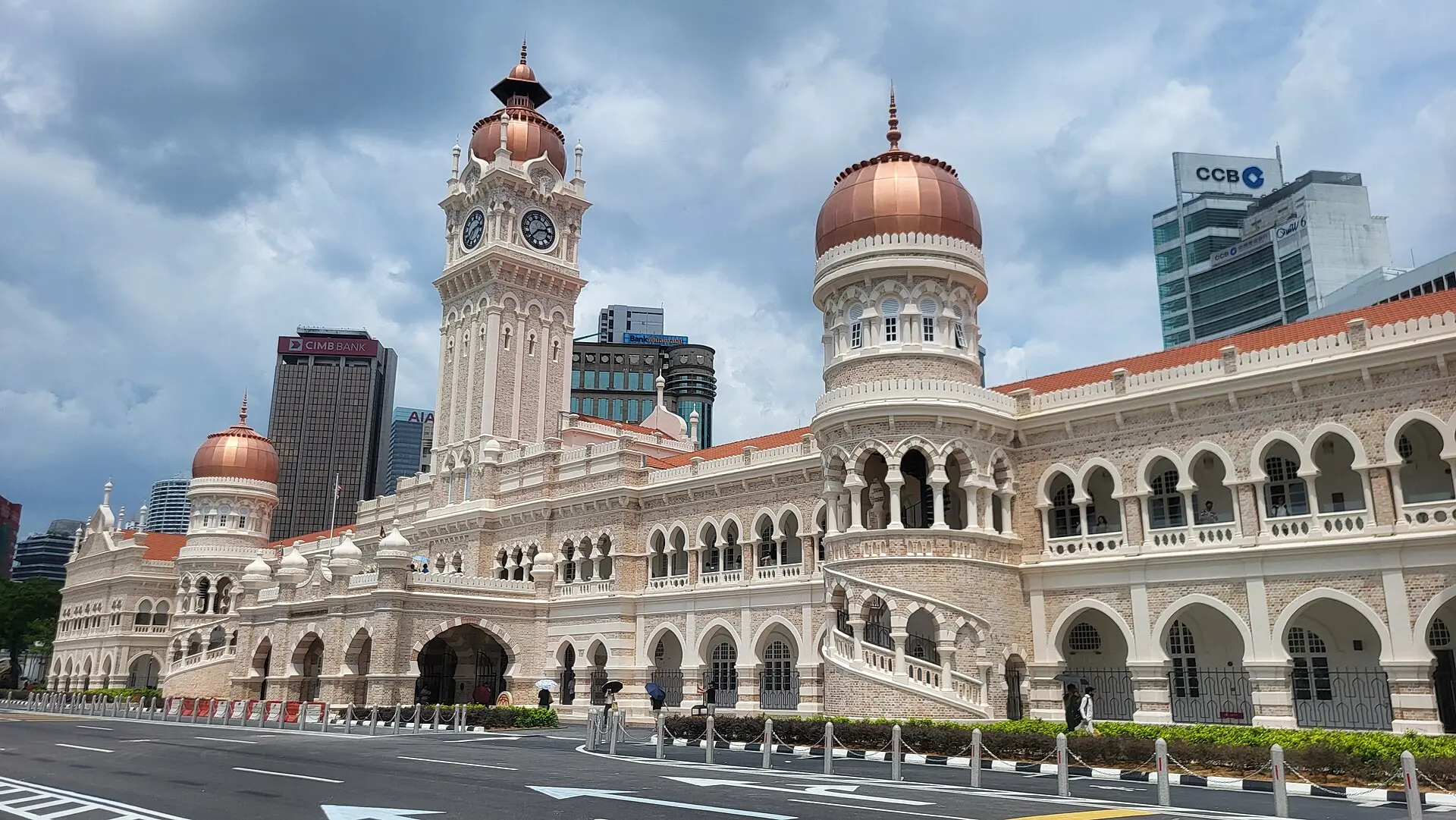
Sultan Abdul Samad Building and Dataran Merdeka
This brick building with its clock tower was completed in 1897 as government offices and was later named after the sultan who reigned while it was built. Its design blends Mughal, Moorish and Gothic ideas. The field in front, once the Selangor Club padang, is now Dataran Merdeka. Here, at midnight as 30 August 1957 turned into 31 August, the Union Jack came down and the flag of the Federation of Malaya went up. The formal declaration of independence followed that morning at Stadium Merdeka.
Sin Sze Si Ya Temple
Tucked between shophouses near Central Market, Sin Sze Si Ya Temple (仙四師爺廟) traces its story to 1864, when Yap Ah Loy brought the spirit tablet of Sheng Ming Li, a Kapitan he had served, to Kuala Lumpur. The temple honours two deified figures whom devotees believe protected Yap during the Selangor Civil War. It is one of Kuala Lumpur’s oldest Chinese temples. Its architecture follows the Cantonese temple style.
Sri Mahamariamman Temple
Founded in 1873, this is the oldest Hindu temple in Kuala Lumpur. Its five-tier gopuram, the gateway tower over the entrance, is covered in sculpted deities. Each year at Thaipusam, a silver chariot carrying Lord Murugan leaves the temple on Jalan Tun H.S. Lee and travels through the night to the Sri Subramaniar Temple at Batu Caves, with thousands of devotees walking alongside.

Kampung Baru
A Malay village in the middle of a modern capital. Local Malays pressed the British administration for land, and on 12 January 1900 the Sultan of Selangor gazetted Kampung Baru as a Malay Agricultural Settlement. It was made up of seven villages, settled by families of Mandailing, Minangkabau, Javanese, Rawa and Melaka descent. Despite the popular belief, the federal territories minister said in 2025 that it is a Malay Agricultural Settlement, not Malay reserve land.
Central Market (Pasar Seni)
Kuala Lumpur has had a market here since 1888. The pale blue Art Deco building you see today dates from 1937. In the 1980s it was set to be demolished. The Malaysian Heritage Society campaigned to save it, and in 1986 it reopened as a centre for Malaysian arts and crafts. It’s one of the country’s early examples of giving an old building a new use.

Why it is worth knowing
Kuala Lumpur moves fast, and its towers draw the eye. But the city’s story is still visible at street level, within a short walk of the river point where it began. A mosque, a clan leader’s temple, a Hindu gateway, a Malay kampung and a market each tell you who came, what they built and how they lived side by side.
Visiting respectfully
- Mosques and temples are places of worship first. Dress modestly and follow the guidance at the entrance.
- Ask before photographing people, prayers or ceremonies.
- Kampung Baru is a living neighbourhood. Respect residents’ homes and privacy.
What is still debated
- Who founded Kuala Lumpur: Raja Abdullah, Yap Ah Loy or Sutan Puasa, depending on the historian.
- Where the name comes from: usually the “muddy confluence” of the Klang and Gombak; one recent study argues for a lost stream called Sungai Lumpur.
- When Sin Sze Si Ya Temple was built: the shrine dates to 1864, but sources give 1875 or the early 1880s for the temple building.
Know a place in Kuala Lumpur with a story we should tell? Write to us at [email protected].
Report an error · Something wrong, incomplete or culturally insensitive? Tell us and we aim to review it within 5 working days.
Questions
How did Kuala Lumpur begin?
Kuala Lumpur began around 1857, when the Selangor chief Raja Abdullah sent Chinese miners up the Klang River to look for tin at Ampang. Many died of disease, but the mines prospered, and traders settled at the landing where the Klang and Gombak rivers meet. That landing grew into the town.
What does Kuala Lumpur mean?
The name is usually translated as "muddy confluence": kuala is a river mouth or meeting point and lumpur means mud. It is usually linked to the meeting of the Klang and Gombak rivers. One recent study argues the name came instead from a lost stream called Sungai Lumpur.
Where was Malaya's independence first celebrated in Kuala Lumpur?
On the padang in front of the Sultan Abdul Samad Building, now Dataran Merdeka. At midnight, as 30 August 1957 turned into 31 August, the Union Jack was lowered and the flag of the Federation of Malaya raised. The formal declaration of independence followed that morning at Stadium Merdeka.
What is Kampung Baru?
Kampung Baru is a Malay settlement in central Kuala Lumpur. It was gazetted as a Malay Agricultural Settlement on 12 January 1900, on land granted by the Sultan of Selangor, and was made up of seven villages. Despite the popular belief, the federal government says it is not Malay reserve land.
Is Aevum available in Kuala Lumpur?
Not yet. Aevum is coming soon to Kuala Lumpur. Our first city is Ipoh. This guide is an early look at the places and stories we are preparing for KL.
Sources
All accessed 31 October 2026.
- Arkib Negara Malaysia, “Detik Jam Tengah Malam Di Padang Kelab Selangor”
- Bangunan Sultan Abdul Samad, official site
- Warisan KL, “Sultan Abdul Samad Jamek Mosque”
- Warisan KL, “Central Market”
- The A.B. Hubback Project, “Jamek Mosque, Kuala Lumpur (1909)”
- Kuala Lumpur Municipal Council, Kuala Lumpur 100 Years (scanned copy)
- Engchoon Kuala Lumpur History Gallery, “The Development and Chinese Pioneering of Kuala Lumpur”
- Kuala Lumpur City, “A Historical Timeline of Kuala Lumpur”
- Review of Abdur-Razzaq Lubis, Sutan Puasa: Founder of Kuala Lumpur, Bijdragen tot de Taal-, Land- en Volkenkunde
- “Muddy Waters: The Lost Sungai Lumpur”, Journal of the Malaysian Branch of the Royal Asiatic Society, 2025
- Roots.gov.sg (National Heritage Board, Singapore), “Klang River”
- Sin Sze Si Ya Temple, “The Establishment of Sin Sze Si Ya Temple”
- Sin Sze Si Ya Temple, “History & Architecture of the Temple”
- “Religion and Localization in Kuala Lumpur: Transformation in the Cult of Sin Sze Si Ya”, Springer Nature
- Malay Mail, “Silver chariot rolls through KL as thousands join Thaipusam procession to Batu Caves”, 31 January 2026
- New Straits Times, “Lord Murugan chariot begins day-long Thaipusam procession to Batu Caves”, February 2025
- UiTM Institutional Repository, paper on early Kuala Lumpur places of worship (PDF)
- Perbadanan Pembangunan Kampong Bharu, “Latar Belakang Kampong Bharu”
- Kampong Bharu study, IOP Conference Series: Earth and Environmental Science, vol. 1151 (PDF)
- Free Malaysia Today, “Kampung Baru not Malay reserve land, says Zaliha”, 6 October 2025
- Central Market Kuala Lumpur, “About”
- Wikipedia, “History of Kuala Lumpur”, “Sultan Abdul Samad Building”, “Sri Mahamariamman Temple, Kuala Lumpur” (cross-check only)