Gastronomy · Explorers
Kopitiam Coffee Cheat Sheet: How to Order Like a Local
How to order coffee in a Malaysian kopitiam: kopi, kopi O, kopi C, kosong, peng and kurang manis, and how to stack the words so you get the cup you want.
By Aevum Editorial, written by Joan V. · Published · Updated
In short: In a Malaysian kopitiam, you order coffee with a short string of words. Plain kopi comes with sweetened condensed milk. Kopi O is black with sugar; kopi C uses evaporated milk and sugar. Add kosong for no sugar, kurang manis for less sweet, and peng for iced. The words stack, so kopi O kosong peng is iced black coffee with no sugar. Tea follows the same pattern, starting from teh.
How do you order coffee at a Malaysian kopitiam?
You order by naming the drink, then the milk, then the sugar, then whether you want it iced. The base words are widely shared in Malaysia and Singapore, and they were already summarised in our explainer What Is a Kopitiam?. This page is the cheat sheet: what to say, how the words combine, and where shops differ.
A Tourism Malaysia feature on BBC explains the Hainanese-style roast — sugar and margarine added to the beans, usually robusta, near the end of the roast — and sets out the standard cup: the default brew is served with sweetened condensed milk. Unsweetened black coffee is kopi O kosong. An unsweetened cup with evaporated milk is kopi C kosong. Black coffee with sugar is kopi O. Coffee with evaporated milk and sugar is kopi C. For an iced drink, add peng at the end.
[Early CTA] Looking for a kopitiam with a story behind the cup? Find heritage coffee shops in Ipoh in the Aevum app. Download the Aevum app (coming soon)
What do the basic kopi orders mean?
The cheat sheet below is the way local drink guides and coffee-shop write-ups usually explain the code. Spellings vary in Latin letters (O or o; peng is sometimes written ping; gau, gao and kau are the same idea). Say the words clearly; the person at the drinks counter will usually understand either spelling. Where guides disagree, the common meaning is given here. Sources for the terms are listed at the end of this page, not in the chart.
| What you say | What you get |
|---|---|
| Kopi | Coffee with sweetened condensed milk |
| Kopi O | Black coffee with sugar (no milk) |
| Kopi C | Coffee with evaporated milk and sugar |
| Kopi O kosong | Black coffee, no milk and no sugar |
| Kopi C kosong | Coffee with evaporated milk, no sugar |
| Kopi peng | Iced kopi (condensed milk, over ice). Peng can be added to the other orders too |
| Teh | Tea, following the same milk and sugar pattern as kopi |
| Teh tarik | “Pulled” tea: milky tea poured between two containers until it froths |
| Teh halia | Tea with ginger |
| Cham (also yin yang or yuan yang) | Coffee and tea mixed in one cup. Some shops treat the mix as roughly equal parts; the taste often leans toward coffee |
| Gao / gau / kau | A thicker, stronger cup. Malaysian guides write gau or kau; gao is the same word with another spelling |
| Po / poh | A weaker, more diluted cup, with more water |
| Di lo / di low | Extra thick: the coffee taken strong, often described as little or no water added, straight from the cloth “sock” |
| Kosong | No sugar |
| Kurang manis | Less sweet. How much less sugar still varies from stall to stall |
| Siu dai / siew dai | Also “less sweet” or less sugar, from Cantonese. Used in Malaysian kopitiam write-ups as well as in Singapore |
| Gah dai / ga dai | Extra sweet, or more sugar |
| Peng | Iced |
| Bungkus | Takeaway (Malay, “wrap”) |
| Tapau | Takeaway (from Cantonese; widely used in Malaysia). Da bao is also heard, especially in Singapore |
Kosong is Malay for “zero” or “empty”. Malay Mail notes that in a drinks order it usually means “without sugar”. The same report gives kopi O kosong as a cup with no sugar and no milk, so it is not mixed with sweetened condensed milk or creamer.
If you only say kopi kosong, the stall may pause. Plain kopi is built on already-sweet condensed milk, so “no sugar” is easier to follow when you also say O or C. Asking for kopi O kosong or kopi C kosong avoids that ambiguity.
Nobody agrees on what the “C” stands for. One story, recorded by Makansutra, links it to Carnation, a brand of evaporated milk. Hainanese coffee-shop keepers in Singapore, in the same report, say it is the Hainanese pronunciation of xian (鲜), “fresh”, as in fresh milk. We keep both accounts, as we do on the kopitiam explainer.
How do the words stack?
A typical order is built in this order:
- The drink: kopi, teh or cham.
- The milk: say nothing for condensed milk, O for no milk, C for evaporated milk.
- The strength: nothing for the usual brew, gau / kau / gao for stronger, po / poh for weaker, di lo / di low for extra thick.
- The sugar: nothing for the usual sweet cup, kurang manis or siu dai / siew dai for less sweet, gah dai for extra sweet, kosong for no sugar.
- The temperature: hot unless you add peng for iced.
- Here or to go: nothing to drink in, bungkus or tapau to take away.
So kopi C kosong is coffee with evaporated milk and no sugar. Kopi O kosong peng is iced black coffee with no sugar. Cham peng bungkus is iced coffee mixed with tea, to take away. Kopi O gau kosong is a stronger black coffee with no sugar.
Kurang manis is Malay for “less sweet”. Malaysian coffee-shop and restaurant operators have talked about it in public as a common request, alongside drinks such as teh si kosong. How much sugar is taken out still depends on the stall. If you need a precise amount, say so in plain words. Siu dai or siew dai is the Cantonese request for the same idea, and it appears in Malaysian kopitiam guides as well as in Singapore. Either will usually be understood; if one draws a blank, try the other, or just say “less sweet”.
What about tea, and teh tarik?
Tea uses the same code. Teh comes with sweetened condensed milk, teh O is black tea with sugar, teh C uses evaporated milk, and peng or kosong can be added in the same way.

Teh tarik is different. The name literally means “pulled tea”. Malay Mail describes it as milky tea poured from one container to another so that a froth forms on top. Some stallholders in that report said they could not make a kosong version, because condensed milk was what gave the drink the body needed for the “pull”. If you want tea with no sugar, teh O kosong or teh C kosong is the more reliable order; ask whether a teh tarik can be made less sweet before you assume it can be made kosong.
Is Ipoh white coffee ordered the same way?
Yes, the same short words are widely understood in Ipoh. Ipoh white coffee is a way of roasting and serving coffee that Malaysians connect with the city’s Old Town: beans roasted with palm-oil margarine, usually with little or no sugar in the roast, then typically served with condensed milk. What “white” means, and who first made it, are still debated; that is why the details live on the dedicated explainer, not in this cheat sheet.
If you want that style without the usual sweetness, white coffee O kosong or a clear request for no sugar will usually be understood. When a shop has its own names on the menu, you can still use the O, C, kosong and peng words, or just describe the cup you want.
What else might you hear?
Shops are not a single dictionary. A few other orders turn up often in Malaysian drink guides:
- Neslo: Nescafé mixed with Milo.
- Michael Jackson: soya bean milk with cincau (grass jelly).
- Goo leng peng (also written gu leng ping): rose syrup with evaporated milk, served iced.
- Teh halia: already in the table; ginger tea, which can also take peng or kurang manis.
- At a mamak stall, you may also hear Malay pekat (strong), cair (weak) and ais (iced), or air suam for warm water.
In Penang, Hokkien shop talk is especially common. Local write-ups there also use kau and poh as above, sorm for warm, juak for hot, kiam liau or cnia for less sugar, and mai liau for no sugar — the same idea as kosong. If a word is unfamiliar in that shop, say what you want in ordinary language: “iced black coffee, no sugar” will do.
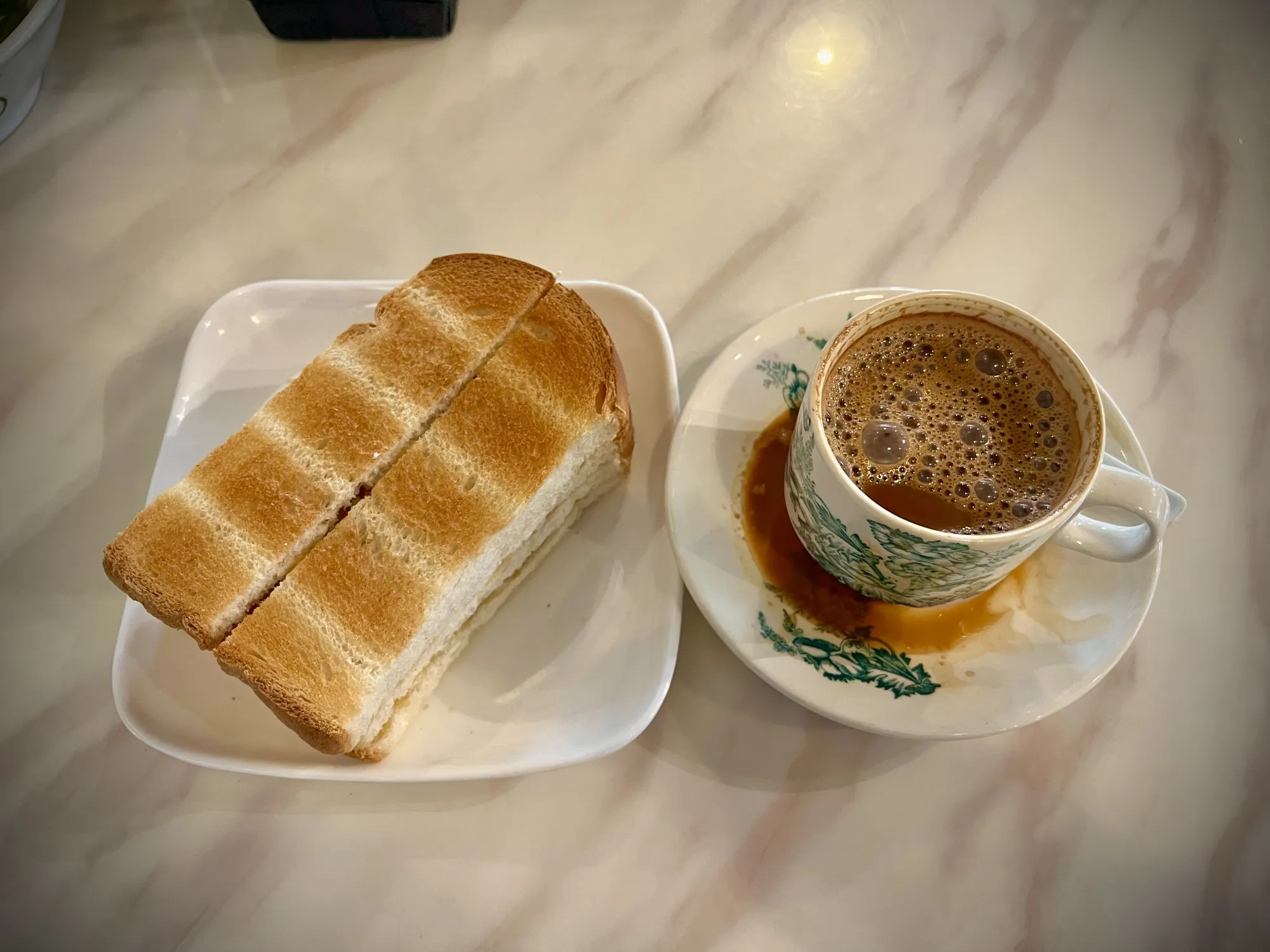
A kopitiam is also a breakfast table. The usual pairing is toast with kaya (a coconut and egg jam) and soft-boiled eggs. For the shop as a social space, and for how kopitiams developed, go back to What Is a Kopitiam?.
[End CTA] Find Ipoh kopitiams and other heritage food shops, and the stories behind them, in the Aevum app. Download the Aevum app (coming soon)
More to read
- What Is a Kopitiam? Malaysia’s Coffee Shop Culture, Explained
- Ipoh White Coffee, Explained
- Why Is Ipoh So Famous for Food?
- When Is Ipoh Crowded?
- Ipoh city guide
- Download the Aevum app (coming soon)
Report an error · Something wrong, incomplete or culturally insensitive? Tell us and we aim to review it within 5 working days.
Questions
How do you order coffee at a Malaysian kopitiam?
Start with kopi for coffee with sweetened condensed milk, or say kopi O for black coffee with sugar, or kopi C for evaporated milk and sugar. Add kosong for no sugar, kurang manis for less sweet, and peng for iced. The words stack, so kopi O kosong peng is iced black coffee with no sugar.
What is the difference between kopi, kopi O and kopi C?
Plain kopi is coffee with sweetened condensed milk. Kopi O is black coffee with sugar and no milk. Kopi C is coffee with evaporated milk and sugar. The meaning of C is still debated: one story links it to the Carnation brand, another to a Hainanese word for fresh.
What does kosong mean in a kopi order?
Kosong is Malay for zero or empty, and in a drinks order it means no sugar. Kopi O kosong is unsweetened black coffee, with no milk and no sugar. If you only say kopi kosong, the stall may hesitate, because plain kopi is made with already-sweet condensed milk. Saying O or C as well avoids the mix-up.
What is the difference between kurang manis and kosong?
Kurang manis means less sweet; kosong means no sugar. Malaysian coffee-shop and restaurant operators have said that requests for kurang manis and for drinks such as teh si kosong or barley kosong are now common. How much less sugar you get can still vary from stall to stall.
Is Ipoh white coffee ordered the same way?
The same kopi, O, C, kosong and peng words are widely understood in Ipoh kopitiams. Ipoh white coffee is a roasting and serving style linked to the city's Old Town, usually drunk with condensed milk. For what 'white' means, and what is still debated, see our separate explainer on Ipoh white coffee.
Sources
All accessed 12 November 2026. The chart above has no per-row citations; the sources for those terms are collected here.
- Samantha Khor, “How To Order Kopitiam Drinks Like A Boss”, SAYS, 30 April 2015 (kopi, gau, poh, C, O, kosong, peng, siu dai, gah dai; teh and teh tarik; teh halia; cham / YinYang; neslo; goo leng ping; Michael Jackson): https://says.com/my/lifestyle/ordering-your-drinks-at-a-malaysian-kopitiam
- Jeremy Ng, “‘Pat Poh Peng’ And 23 Other Drinks You Can Order At Penang Kopitiams”, SAYS, 14 July 2022 (peng, kau, poh, sorm, juak, kiam liau / cnia, mai liau, cham peng, neslo, Michael Jackson, goo leng peng): https://says.com/my/seismik/makan/drinks-you-can-order-at-penang-kopitiams
- eatMy, “How to order kopi in Malaysia and Singapore: kopi O, C, kosong, peng” (po, kau, di lo, cham, tapau / bungkus, kurang manis, pekat / cair / ais, air suam; notes siew dai, gao and da bao as more common in Singapore, with Malaysian kurang manis and kau): https://eatmy.my/eat-like-a-local/
- Rise Malaysia, “Kopitiam Drinks Guide: 10 Essential Orders to Sip Like a Local” (siu dai, gah dai, gau, poh, peng or ais, cham): https://risemalaysia.com.my/kopitiam-drinks-guide-essential-orders/
- Rosenun, “How Many Languages Are in a Cup of Kopi? Decoding Malaysia’s Kopitiam Menu” (gao / kaw, po / poh, cham, siew dai, kurang manis, tapau / tapao, minum sini): https://rosenun.com/article?id=29&lang=en&slug=article-1788285605
- National Library Board Singapore, BiblioAsia 14(3), 10 October 2018, “Makan Places and Coffee Socks” (kopi, kopi c, kopi gao, kosong, teh, kaya toast): https://biblioasia.nlb.gov.sg/all-sections/vol-14-issue-3-oct-dec-2018-makan-place-coffee-socks/
- Tourism Malaysia feature on BBC.com, “The perfect pour: Exploring Malaysia’s coffee culture” (kopi, kopi O, kopi C, kosong, peng; Hainanese roast; Ipoh white coffee as a local style): https://www.bbc.com/storyworks/travel/selamat-kembali-to-malaysia/the-perfect-pour-exploring-malaysias-coffee-culture
- Malay Mail, Soo Wern Jun, “‘Jom Kosong’: Are you willing to skip sugar in your ‘teh tarik’ and ‘kopi’ to save 20 sen?”, 27 October 2024 (kosong; kopi O kosong; teh tarik; some stalls unable to make teh tarik kosong): https://www.malaymail.com/news/malaysia/2024/10/27/jom-kosong-are-you-willing-to-skip-sugar-in-your-teh-tarik-and-kopi-to-save-20-sen/154356
- The Star, Fazleena Aziz, “Kurang manis satu, but what’s in it?”, 30 October 2025 (kurang manis; teh si kosong): https://www.thestar.com.my/news/nation/2025/10/30/kurang-manis-satu-but-whats-in-it
- Makansutra, “What does C in Teh-C mean?”, 2012 (Carnation versus Hainanese xian): https://makansutra.com/what-does-c-in-teh-c-mean/
- Aevum, What Is a Kopitiam? and Ipoh White Coffee, Explained